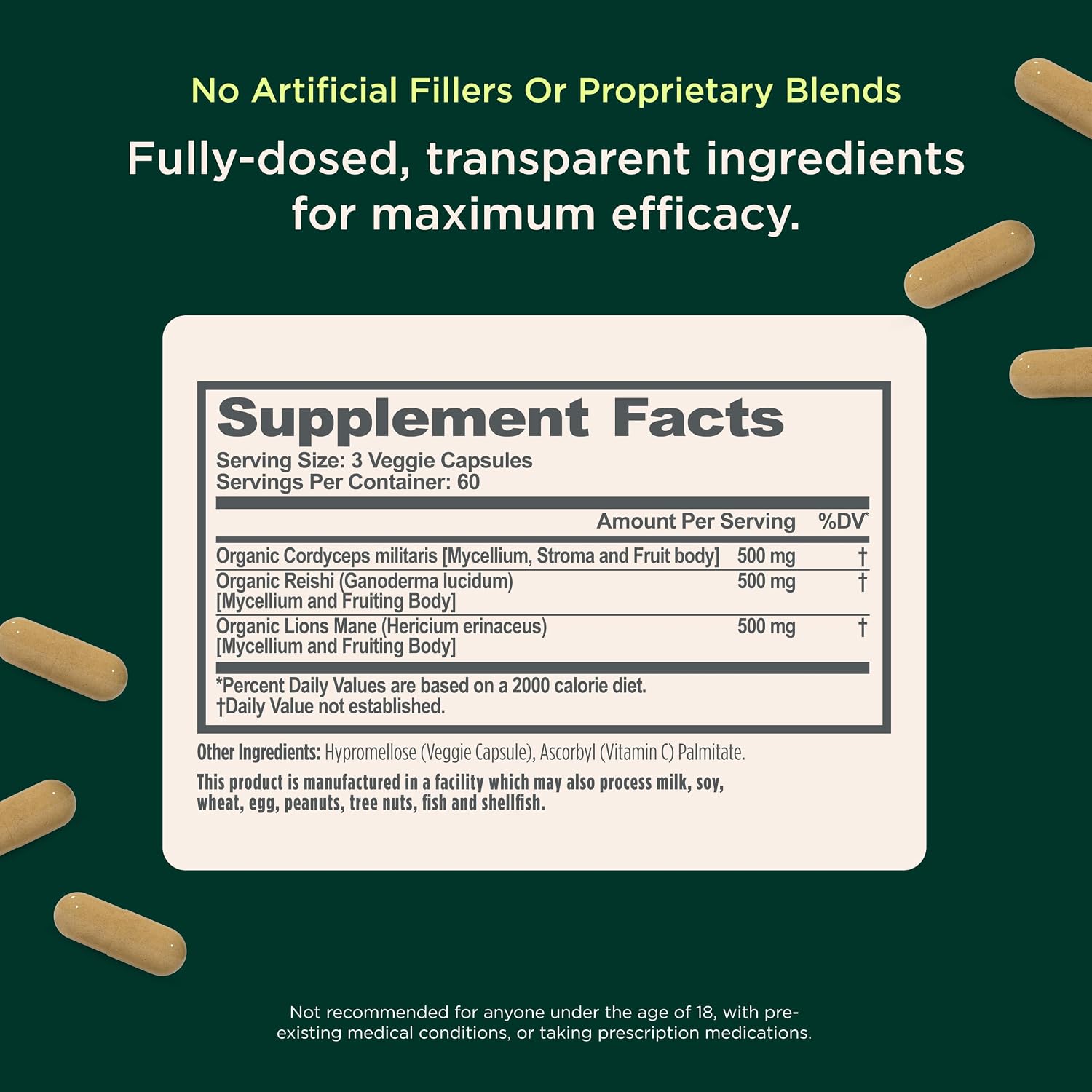
You’ve probably seen the label: “10 Mushroom Blend — Lion’s Mane, Reishi, Chaga, Turkey Tail, Cordyceps, Shiitake, Maitake, King Trumpet, Tremella, Agarikon.” It sounds comprehensive. Impressive, even. But if you’ve spent any time looking at nootropic supplements — products designed to support memory, focus, and overall brain health — you’ve probably started to wonder: when ten species share a 2,000 mg capsule, how much of any one of them are you actually getting? That’s the core question this guide answers. We’ll break down what the research says about effective doses for the most-studied mushroom species, show you the arithmetic on what multi-blends typically deliver, and give you a clear decision framework so you know exactly when a blend makes sense and when a single-species extract is the smarter buy.
| EDITOR'S PICK[Host Defense MyCommunity Capsul…](https://www.amazon.com/dp/B002WJ1BZK?tag=greenflower20-20) | Mid-tier[Host Defense Mushrooms Lion's M…](https://www.amazon.com/dp/B00OVF9DVM?tag=greenflower20-20) | Budget pick[Clean Nutraceuticals Lions Mane…](https://www.amazon.com/dp/B0DNTZ4MVB?tag=greenflower20-20) | |
|---|---|---|---|
| Species count | 17 | 1 | 20 |
| Form | Capsules | Capsules | — |
| Capsule count | 120 | 120 | — |
| Price | $53.96 | $47.21 | $29.95 |
| See on Amazon → | See on Amazon → | See on Amazon → |
The Dose Problem Hidden Inside Every Multi-Blend
Let’s start with arithmetic, because this is where most buyers get misled.
A standard mushroom supplement capsule holds roughly 500–700 mg. Most multi-blend products deliver two capsules per serving — so you’re working with a ceiling of about 1,000–1,400 mg total. Split that evenly across ten species, and you land at 100–140 mg per mushroom per serving.
Now look at what the clinical literature actually uses. According to Examine.com’s Hericium erinaceus Research Summary (2024 update) and Examine.com’s Ganoderma lucidum Research Summary (2024 update), human trials have generally used the following dose ranges:
| Species | Clinically studied dose range | What a 10-in-1 blend typically delivers |
|---|---|---|
| Lion’s Mane (Hericium erinaceus) | 500–3,000 mg/day | ~100–200 mg |
| Reishi (Ganoderma lucidum) | 1,000–5,400 mg/day | ~100–200 mg |
| Cordyceps (Cordyceps militaris) | 1,000–3,000 mg/day | ~100–200 mg |
| Turkey Tail (Trametes versicolor) | 1,500–3,000 mg/day (immune studies) | ~100–200 mg |
That gap is not a rounding error. It’s a 5x to 15x difference between what studies used and what a blend delivers. This doesn’t automatically mean a blend is useless — but it does mean you are not getting clinical doses of anything. You’re getting a sampling platter, not a therapeutic serving.
Why Brands Build Blends (And Why It Works as Marketing)
To be fair to the category, there are legitimate arguments for multi-blends. Understanding them helps you evaluate which ones are worth their price.
The synergy argument. Some formulators and researchers suggest that polysaccharides, beta-glucans, and triterpenes from different species may work through overlapping but complementary pathways — immune modulation, neurotrophin support, adaptogenic stress response — and that sub-clinical doses of several species might produce additive effects. This is biologically plausible but not yet well-demonstrated in human trials. As noted in both the Examine.com Hericium erinaceus Research Summary and the Examine.com Ganoderma lucidum Research Summary (2024 updates), the mechanistic data is compelling but most human trial evidence remains preliminary or limited in scale.
The breadth argument. If you’re not targeting a specific outcome — you just want general cognitive and immune support — a blend gives you exposure to a wider range of bioactive compounds without managing five separate bottles. For general wellness at moderate spend, that’s a reasonable position.
The cost-per-serving argument. A 10-in-1 blend at $30/month looks cheaper than five single-species products at $20–$30 each. Taken at face value, that math holds. But the comparison breaks down if the blend’s doses are too low to do anything meaningful, and a single-species extract is dosed to match what studies actually used.
The label transparency problem. ConsumerLab’s 2024 Mushroom Supplement Review found significant variation in actual beta-glucan content across popular products, with some multi-blend products delivering far less of the key active compounds than their labels implied. When total weight is disclosed but per-species dosing is not, you cannot evaluate what you’re buying. That opacity is a feature for the brand and a liability for the consumer.
The Fruiting Body vs. Mycelium Variable
Before you can even evaluate dose, you need to know what part of the mushroom you’re getting. This distinction matters enormously and is routinely obscured.
Fruiting body refers to the actual mushroom cap and stem you’d recognize visually. It is higher in beta-glucans — the immune-active polysaccharides — and in species-specific compounds like hericenones and erinacines in lion’s mane. This is what most clinical studies used.
Mycelium on grain (MOG) refers to the root-like fungal network, typically grown on oats or rice and processed with the substrate intact. It has lower beta-glucan content and higher starch content from the grain carrier. It is substantially cheaper to produce.
As Mindbodygreen’s 2023 article on mycelium vs. fruiting body extracts explains, many budget blends use mycelium on grain because it is faster and less expensive to cultivate at scale. The practical result: you may be paying for mushroom branding while consuming mostly grain starch. A product label that says “organic mushroom blend” without specifying fruiting body, beta-glucan percentage, or extraction method tells you almost nothing useful about potency.
What to look for on a label:
- “Fruiting body extract” explicitly stated
- Beta-glucan content disclosed (a quality lion’s mane fruiting body extract typically shows 25–40% beta-glucans)
- Extraction ratio or hot water/dual extraction noted (bioactive polysaccharides require hot water extraction to be bioavailable)
- No ambiguous “whole mushroom” language unless beta-glucan content is independently verified
The National Institutes of Health Office of Dietary Supplements, in its consumer guidance document “Dietary Supplements: What You Need to Know,” notes that supplement manufacturers are not required to prove efficacy or consistent potency before sale. That means the quality-control burden falls entirely on the buyer and on third-party testing organizations such as ConsumerLab.
Comparing Your Options: Budget, Mid-Tier, and Premium
The real question isn’t “blends vs. single-species” in the abstract — it’s which product tier matches your goals and budget. Here’s how the decision breaks down across three realistic buyer profiles.
H3: Budget Tier — The Exploration Phase Buyer
You’re new to mushroom supplementation. You don’t have a specific cognitive or immune target yet. You want to survey the landscape for under $35/month without committing to a high-dose single-species protocol.
At this tier, a transparent multi-blend can make sense — but only if it clears minimum quality standards: fruiting body specified, beta-glucan content disclosed, and no undisclosed proprietary blending that hides per-species dosing. At 100–200 mg per species, you are not getting therapeutic doses of anything. What you are getting is broad-spectrum exposure that can help you identify which species your body responds to before you invest more.
Healthline’s 2023 overview of lion’s mane dosing notes that even lower-dose exposure is sometimes used in shorter observational contexts, though it cautions that clinical benefit studies have consistently used doses well above what most blends provide. Treat the budget blend as a discovery phase, not a maintenance phase.
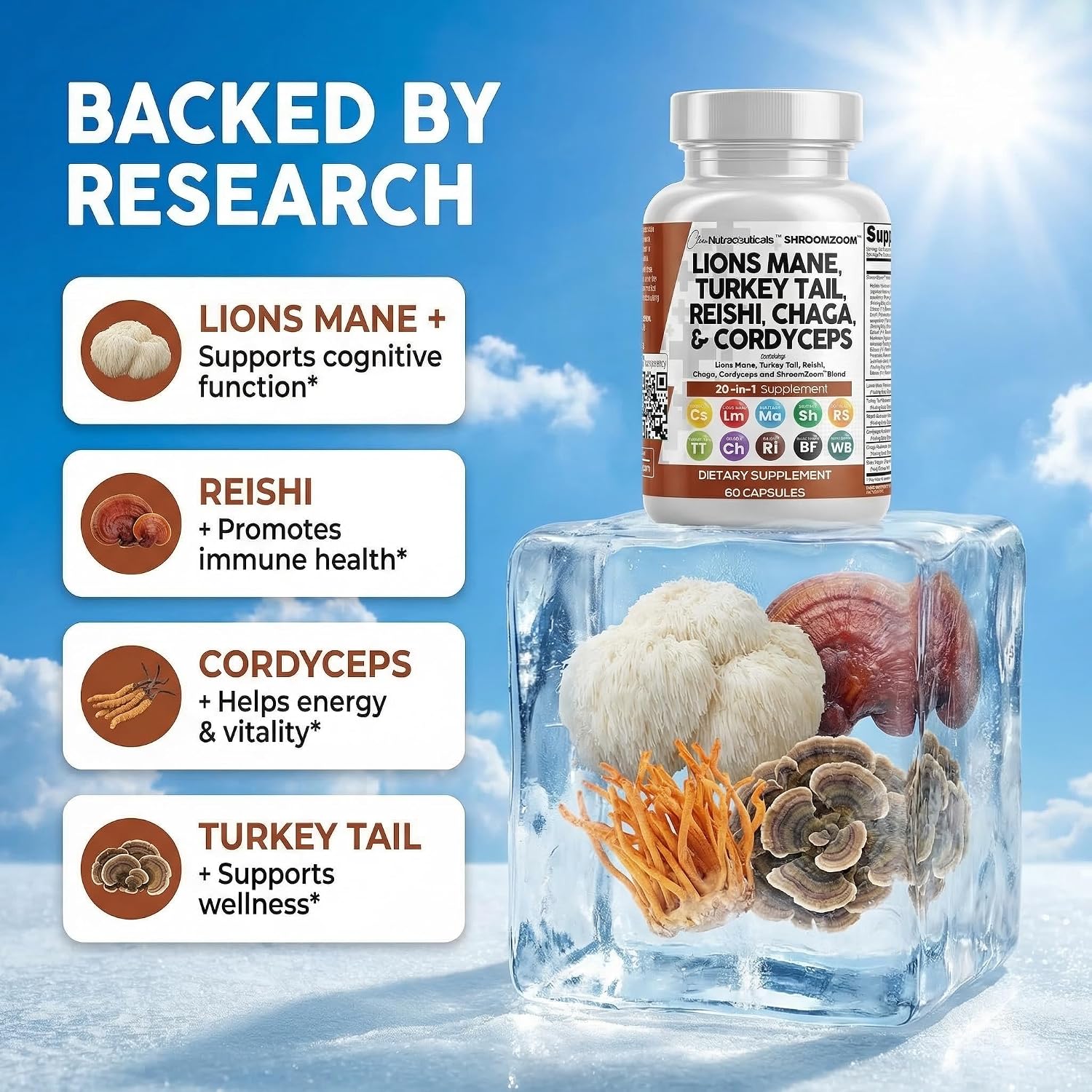
Clean
$29.95
In stock on Amazon
Check price on AmazonH3: Mid-Tier — The Targeted Outcome Buyer
You’ve identified a priority: cognitive support, stress modulation, or immune loading. You’re spending $35–$55/month and want the best return on that dollar.
At this tier, the price-per-effective-dose math strongly favors a single-species extract. A quality lion’s mane fruiting body extract at 500 mg per capsule, taken at two to three capsules daily, puts you in or near the 1,000–3,000 mg range that Examine.com’s Hericium erinaceus Research Summary identifies as the range most human trials used. A multi-blend at the same monthly spend delivers roughly 100–200 mg of lion’s mane — well below that threshold.
ConsumerLab’s 2024 Mushroom Supplement Review also noted that simpler single-species formulations tended to show more consistent quality on independent testing than complex multi-ingredient blends, where verifying every component adds cost that many brands choose not to absorb. At the mid-tier, consistency of potency matters as much as the label dose.
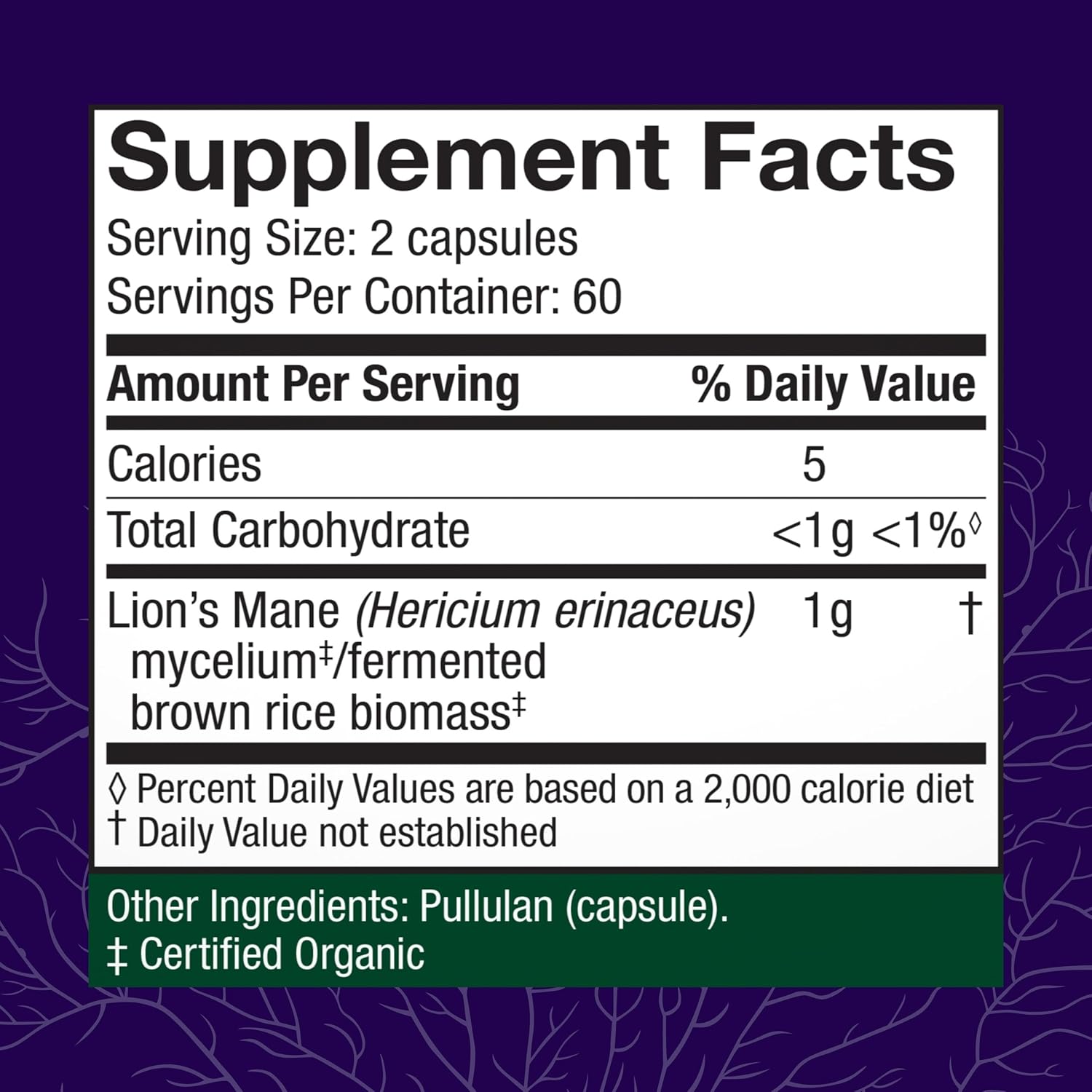
Host
$47.21
In stock on Amazon
Check price on AmazonH3: Premium Tier — The Well-Formulated Blend or Stack Buyer
A small number of premium brands do disclose per-species dosing in their blends and dose key species at or near clinically relevant levels. If a blend clearly shows 750 mg of lion’s mane fruiting body extract alongside meaningful doses of reishi and cordyceps, you are no longer choosing between breadth and potency — you’re choosing a well-formulated blend, which is a categorically different product from the undisclosed proprietary blends that dominate most of this category.
These products exist, but they are the exception. They typically cost $60–$100/month. That price is defensible if the per-species dosing is disclosed, fruiting body is specified, and beta-glucan content is either stated on the label or verified by a third party such as ConsumerLab. At this tier, you’re paying for both breadth and potency — not one at the expense of the other.
If your budget allows and you’ve already completed a discovery phase with a lower-cost blend, a well-formulated premium stack is the logical next investment.
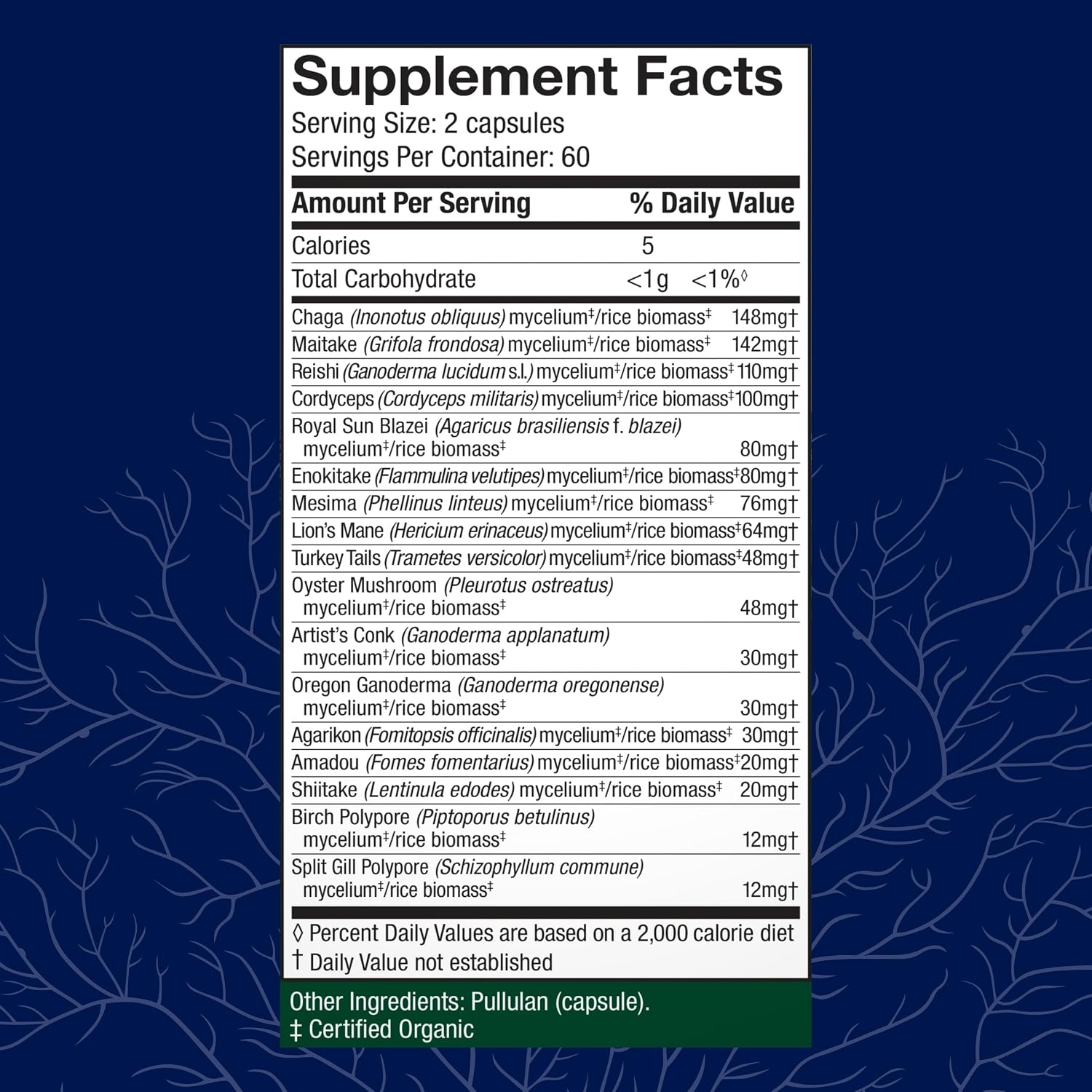
Host
$53.96
In stock on Amazon
Check price on AmazonThe Decision Rule
The label tells you almost everything you need to know. Here is the decision framework in plain terms:
Choose a multi-blend if: You are in an exploration phase, spending under $35/month, and the brand discloses per-species dosing, specifies fruiting body extraction, and shows beta-glucan content. Use it to identify what your body responds to.
Choose a single-species extract if: You have a specific target outcome — cognitive support from lion’s mane, stress modulation from reishi, endurance support from cordyceps — and you’re spending $35/month or more. Put that budget into one extract dosed within range of what clinical studies actually used. You will get measurably more value from 1,000 mg of quality lion’s mane than from 100 mg of lion’s mane diluted across nine other species at equally sub-therapeutic doses.
Choose a premium transparent blend if: You want both breadth and potency, your budget is $60–$100/month, and the brand clearly discloses that at least one or two target species are present at clinically relevant doses with verified beta-glucan content.
The one rule that applies at every tier: if per-species dosing is not disclosed, treat it as a disqualifying red flag — not because the brand is necessarily dishonest, but because you cannot evaluate a product you cannot read. In this category, label transparency is the most reliable proxy for formulation quality, and the brands confident in their products are almost always the ones willing to show you exactly what’s in them.