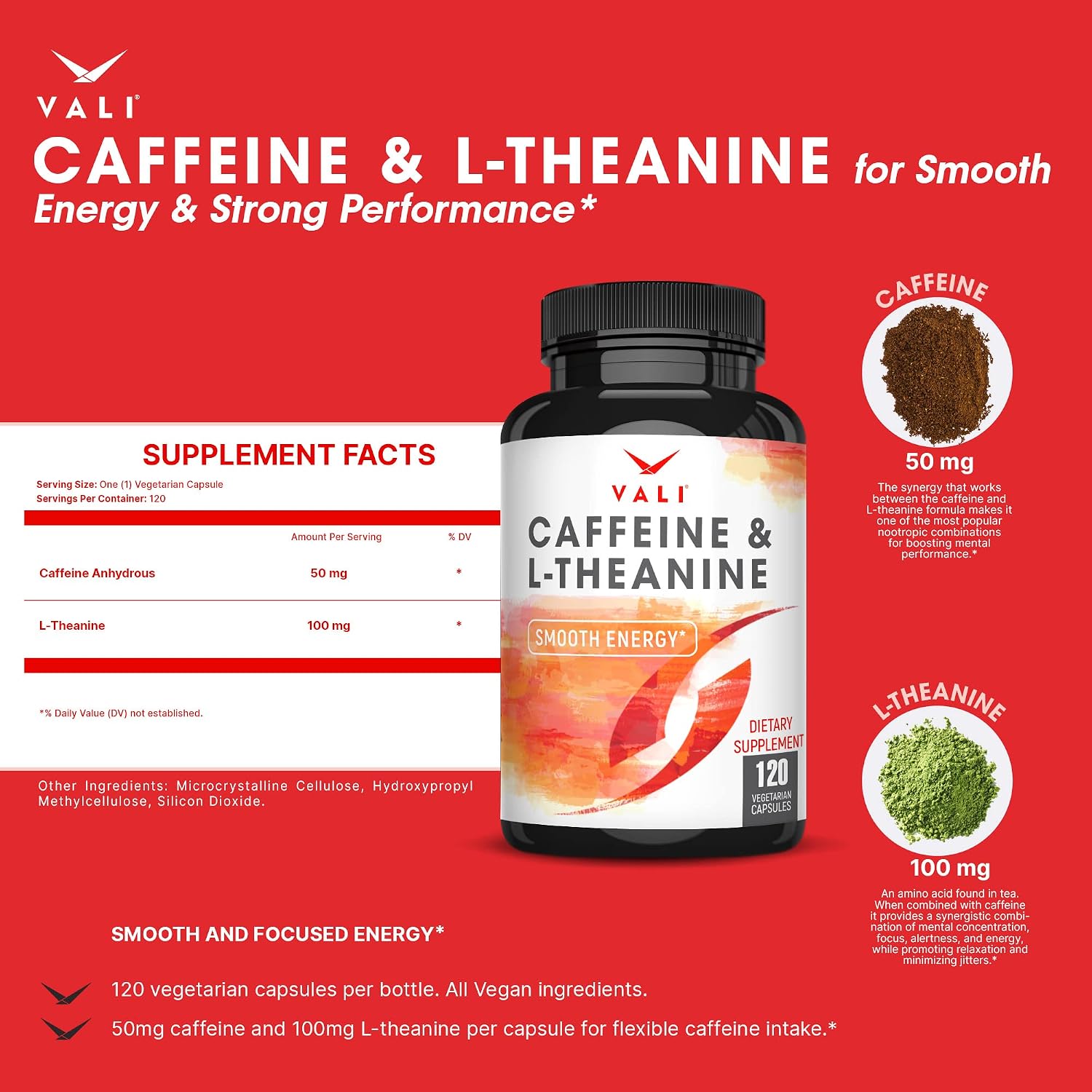
You’ve probably already heard that you should be careful about too much caffeine — the stimulant found in many energy drinks and common supplements — because it can make you jittery or anxious. What you may not know is that pairing it with L-theanine (an amino acid, meaning a building block of protein, found naturally in green tea leaves) essentially turns down that anxious edge while keeping — and in some studies, sharpening — the focus benefits. Together, caffeine and L-theanine form what the nootropics world (nootropics = substances studied for cognitive enhancement) calls a “stack,” meaning two or more compounds taken together because their combined effect is better than either alone. This article breaks down the science, the math, and the specific buying decisions so you can decide whether this $0.10–$0.15-per-dose combination deserves a permanent spot in your protocol — or whether you’re already getting it covered inside a pricier product you’re already taking.
If you’re managing a supplement budget, comparing formulations, or trying to decide whether a $75 multi-ingredient nootropic blend is actually delivering more than its most famous ingredient pair, this is the analysis to read first.
What the Research Actually Shows (And What It Doesn’t)
Let’s be direct about the evidence tier here: caffeine + L-theanine is not a fringe stack supported by one industry-funded pilot study. It’s among the most replicated pairings in cognitive neuroscience literature.
A 2008 study by Haskell and colleagues, published in Biological Psychology, found that the combination — at 150 mg caffeine and 250 mg L-theanine — improved speed and accuracy on attention-switching tasks and reduced susceptibility to distraction compared to either compound alone or placebo. A separate 2008 study by Owen et al., published in Nutritional Neuroscience, replicated the attention and alertness benefits at a 50 mg / 100 mg ratio (caffeine / L-theanine), which is closer to the lower end of popular supplement doses. Giesbrecht and colleagues (also Nutritional Neuroscience, 2010) confirmed improved cognitive performance and reduced mental fatigue during sustained attention tasks.
The mechanism the research points to: caffeine blocks adenosine receptors — adenosine is a chemical your brain accumulates to signal tiredness — producing alertness. The drawback is that caffeine also elevates cortisol and activates the sympathetic nervous system, which is why some people feel anxious, get heart palpitations, or experience focus that is too scattered. L-theanine promotes alpha-wave brain activity (the kind associated with relaxed alertness, like the mental state during light meditation), partially buffering caffeine’s anxiety-producing effects without blunting wakefulness. Per Examine.com’s L-theanine compound summary, alpha-wave increases from L-theanine are detectable within 30–45 minutes of ingestion.
What the research does NOT show:
- Long-term cognitive enhancement beyond acute sessions (most studies are single-dose, short-duration)
- Memory consolidation benefits comparable to what’s claimed for lion’s mane or bacopa monnieri stacks
- Performance benefits at very high caffeine doses (300 mg+) where anxiety-buffering may be insufficient regardless of theanine dose
The honest framing: this stack is best characterized as a reliable, well-understood acute focus tool — not a neuroplasticity intervention.
The Ratio Question: Why 1:2 (Caffeine:Theanine) Is the Standard Starting Point
Most practitioners land on a 1:2 mass ratio — meaning for every milligram of caffeine, you take two milligrams of L-theanine. At a practical dose, that’s usually:
- 100 mg caffeine / 200 mg L-theanine (moderate, good starting point for caffeine-sensitive individuals)
- 150 mg caffeine / 300 mg L-theanine (the most commonly studied range in the Haskell and Giesbrecht trials)
- 200 mg caffeine / 400 mg L-theanine (upper range; suitable for habituated caffeine users, though tolerance effects reduce return)
The 1:2 ratio isn’t pharmacologically sacred — it’s a heuristic that emerged from the literature where effects were most consistently positive. Per Examine.com’s caffeine summary, caffeine’s half-life in healthy adults averages 5–6 hours, meaning a morning dose can still contribute to sleep disruption if taken after noon. L-theanine has a shorter effective window (roughly 3–5 hours for peak alpha-wave effects), which is part of why the combination is typically taken as a single co-administered dose rather than staggered.
By the numbers:
| Format | Cost per 100 mg caffeine dose | Cost per 200 mg L-theanine dose | Combined cost per stack |
|---|---|---|---|
| Bulk powder (no brand) | ~$0.02 | ~$0.05 | ~$0.07 |
| Branded capsules (mid-tier) | ~$0.05 | ~$0.10 | ~$0.15 |
| Pre-combined capsule products | ~$0.12–$0.25 | (bundled) | ~$0.12–$0.25 |
| Included in $80 multi-ingredient stack | $3.50–$6.00 | (bundled) | $3.50–$6.00+ per serving |
Prices based on May 2026 market survey of major retail channels. Bulk powder prices assume reputable vendors with third-party COAs (certificates of analysis).
The Sourcing Decision: Bulk Powder vs. Capsules vs. Pre-Combined Products
This is where the practitioner-level tradeoffs become concrete.
Bulk powder delivers the lowest cost-per-dose by a significant margin, but introduces two real risks: dosing accuracy and sourcing quality. Without a milligram-accurate scale (a $15–$25 investment), you cannot reliably dose either compound. L-theanine is relatively forgiving — the difference between 180 mg and 220 mg is unlikely to produce adverse effects — but caffeine is not. A 50% dosing error on caffeine (measuring 150 mg instead of 100 mg by volume rather than weight) is enough to push sensitive users into jitter territory. ConsumerLab’s 2024 caffeine supplements review flagged dosing accuracy as a consistent variable in powder formats. If you’re recommending this stack to clients or building it into a program, capsules are the safer standardization play.
Separate branded capsules (a caffeine capsule + an L-theanine capsule, taken together) offer good transparency: you know exactly what’s in each capsule because each ingredient has its own label and ideally its own third-party certification. Look for NSF Certified for Sport or Informed Sport certification if the person taking the stack is subject to sports drug testing (neither caffeine at normal doses nor L-theanine is a banned substance, but cross-contamination risk from poorly manufactured facilities is real). The minor inconvenience is swallowing two capsules instead of one.
Pre-combined capsules (caffeine + L-theanine in a single capsule) are the most convenient format and typically cost $0.12–$0.25 per dose, which is still dramatically cheaper than any multi-ingredient nootropic stack. The tradeoff: you’re locked into the manufacturer’s ratio and dose. If you need 200 mg of caffeine but the pre-combined product delivers 100 mg, you’d need to double the dose — which also doubles your theanine intake to 400 mg, which is fine but wasteful if 200 mg theanine is sufficient for you.
Pre-combined inside a $70–$119 multi-ingredient stack: This is the most common scenario for intermediate practitioners evaluating products like Thesis, Alpha Brain, or Qualia Mind. Here’s the honest math: if a product costs $3.50–$6.00 per serving and its primary acute cognitive effect is delivered by the caffeine + L-theanine component (often the only ingredients in the formulation with strong acute-effect evidence), you are paying a significant premium for the remaining ingredients — which may have real long-term value (lion’s mane fruiting body, phosphatidylserine, bacopa) or may be present at sub-clinical doses in a proprietary blend. Proprietary blends, where the manufacturer lists all ingredients but hides individual milligram amounts behind a single “blend” total weight, are a red flag the site consistently flags — and they’re common in this category. You cannot verify whether the bacopa dose hits the 300 mg/day threshold with evidence behind it if the label just says “cognitive blend 650 mg.”
If you’re using a multi-ingredient stack primarily for the caffeine + L-theanine effect, building those two compounds separately and evaluating the rest of the stack’s ingredients on their own merits is the cleaner analytical approach.
Third-Party Testing: What to Require Before You Buy
Given that caffeine is a stimulant and dosing accuracy genuinely matters, third-party verification matters more here than for, say, a magnesium glycinate product where a 10% dosing variance is inconsequential.
Minimum standard for any caffeine-containing supplement: look for a Certificate of Analysis (COA) from a third-party lab confirming the stated caffeine content. ConsumerLab’s 2024 review of caffeine supplements found that most major branded capsule products were accurate within acceptable variance, but some bulk-labeled products showed meaningful discrepancies.
For athletes or anyone subject to sports testing: Informed Sport certification (which tests each batch for banned substances) is the meaningful credential. NSF Certified for Sport is the other primary standard.
L-theanine has a cleaner manufacturing risk profile, but purity still matters. Suntheanine is a trademarked form of L-theanine (produced by Taiyo International) that has been used in most of the published human studies — it’s a reasonable quality signal but not strictly necessary, as generic L-theanine from reputable manufacturers with COAs performs similarly based on published spec comparisons.
The Decision Framework: If X, Then Y
If you’re primarily chasing acute focus for work sessions and your budget is the constraint: Build the stack yourself with separate capsules from verified vendors. Spend $15–$25 total for a 2–3 month supply. Confirm COAs are available before purchasing.
If you’re recommending this stack to clients or employees at scale: Pre-combined capsules with Informed Sport or NSF certification reduce liability and standardize dosing. The cost premium over bulk is worth the defensibility.
If you’re currently paying $70–$119/month for a multi-ingredient nootropic that contains caffeine + L-theanine: Audit the label. If those two ingredients are the primary acute-effect drivers and the remaining ingredients are in a proprietary blend without disclosed mg amounts, you’re likely overpaying for the acute effect. The multi-ingredient product may still be worth it if the long-term-evidence ingredients (lion’s mane fruiting body at 500 mg+, bacopa at 300 mg+, phosphatidylserine at 100 mg+) are present at clinical doses and transparently disclosed — but that’s the question to answer before renewing.
If you’re caffeine-sensitive or managing anxiety: Start at 50 mg caffeine / 100 mg L-theanine, not the 150/300 range. The literature shows measurable benefits even at lower doses, and the anxiety-buffering ratio remains useful. As always: consult with a physician before adding stimulants to your protocol if you’re managing cardiovascular conditions, anxiety disorders, or taking medications — SSRIs in particular can interact with stimulants in ways that affect tolerability, and this is a conversation for a clinician, not a supplement guide.
The bottom line, based on the research reviewed: caffeine + L-theanine is the rare case where the cheapest credible option is also the most evidence-supported acute cognitive intervention available at retail. The $0.15-per-dose stack doesn’t need to compete with $80 bottles. The $80 bottles need to prove they’re doing something the $0.15 stack isn’t already doing — and in transparent, clinical-dose disclosure terms, many of them haven’t made that case yet.