You’ve probably looked at two Bacopa supplements side by side — one at $14, one at $45 — both labeled “500 mg Bacopa Monnieri,” and wondered what you’re actually paying for. Bacopa Monnieri is a creeping herb used in Ayurvedic medicine for centuries; modern research suggests it can meaningfully support memory retention and reduce anxiety, particularly with consistent use over 8–12 weeks. The catch is that the raw herb contains wildly variable concentrations of the compounds that actually drive those effects — a class of molecules called bacosides (the active constituents responsible for Bacopa’s cognitive benefits). So a label that says “500 mg” tells you almost nothing useful. What matters is the standardized bacoside percentage — how much of that 500 mg is actually the stuff that works. This guide breaks down how to read that number, what the clinical research actually used, and how to decide whether you’re looking at a real cognitive investment or an expensive placebo.
| EDITOR'S PICK[Pure Encapsulations Bacopa Monn…](https://www.amazon.com/dp/B0016LL9IY?tag=greenflower20-20) | Mid-tier[Himalaya USDA Organic Bacopa Mo…](https://www.amazon.com/dp/B0006NZPGA?tag=greenflower20-20) | Budget pickBacopa Monnieri Capsules 20% Ba… | |
|---|---|---|---|
| Bacosides | — | — | 20% |
| Count | 180 | 60 | 90 |
| Organic | — | ✓ | — |
| Price | $55.00 | $25.99 | $17.95 |
| See on Amazon → | See on Amazon → | See on Amazon → |
The Bacoside Problem: Why Raw Milligrams Mislead You
Here’s the core issue in plain math: if a product contains 500 mg of Bacopa extract standardized to 20% bacosides, you’re getting 100 mg of active bacosides. If a competing product offers 300 mg standardized to 55% bacosides, you’re getting 165 mg of active bacosides from a smaller capsule at the lower milligram count. The first product looks bigger on the label. The second product delivers more of what the research actually studied.
This isn’t a minor technicality. Across aggregated reviews and independent lab analyses, ConsumerLab’s Bacopa Supplements Review (2024) found meaningful variation in actual bacoside content between products claiming equivalent raw weights — some delivering less than half the active compounds their label implied. That gap is the difference between a clinical dose and a sub-threshold amount that’s unlikely to do much of anything.
The two standardization benchmarks you’ll see most often:
- 20% bacosides — the historical baseline used in many older formulations; technically standardized but toward the low end
- 45–55% bacosides — the range used in most peer-reviewed human trials and considered clinically relevant by researchers
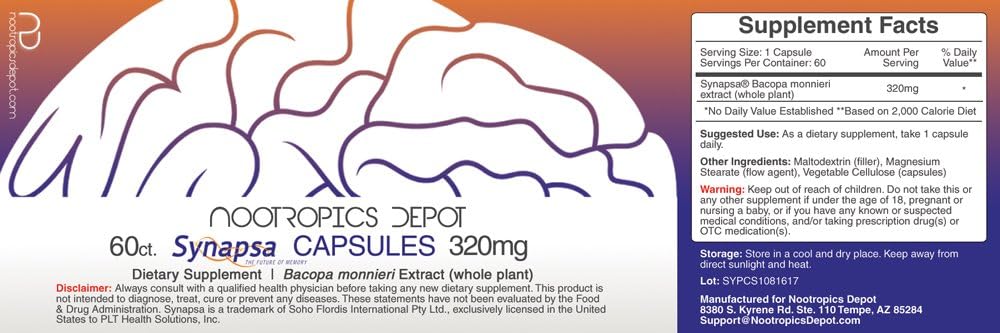
The gold-standard branded extract you’ll encounter most in well-formulated products is Bacognize (standardized to 45% bacosides) and Synapsa (a KeenMind-lineage extract that tracks a specific bacoside profile across multiple randomized controlled trials). When you see either of those named on a label, the standardization has been independently validated — that matters more than any marketing copy on the front of the bottle.
What the Clinical Research Actually Used (And What That Means for Dosing)
If you’re making a purchase decision, anchor it to what the published trials dosed, not to what the marketing suggests.
By the numbers:
| Study | Extract / Standardization | Daily Dose | Duration | Primary Outcome |
|---|---|---|---|---|
| Stough et al., Psychopharmacology 2001 | Keenmind / ~55% bacoside equivalent | 300 mg extract | 12 weeks | Improved verbal learning, memory consolidation |
| Calabrese et al., JACM 2008 | Synapsa-lineage | 300 mg extract | 12 weeks | Memory, anxiety reduction in elderly |
| Morgan & Stevens, JACM 2010 | 320 mg Synapsa | 320 mg extract | 90 days | Improved word recall and depression scores |
The pattern that emerges across the research Examine.com’s Bacopa compound page synthesizes: 300–320 mg of a well-standardized extract (45–55% bacosides), taken daily for at least 8–12 weeks, is the range that produced measurable cognitive effects in controlled trials. Sub-200 mg doses, shorter durations, or lower standardization levels showed weaker or inconsistent results.
Two additional notes that practitioners get wrong:
-
Bacopa is fat-soluble. Taking it with a meal containing some dietary fat meaningfully improves absorption — this is consistent across the pharmacokinetic literature and noted explicitly by Examine.com. A product that doesn’t mention this in its dosing guidance is leaving efficacy on the table.
-
Effects are cumulative, not acute. Bacopa doesn’t feel like anything on day one. Its mechanism — upregulating antioxidant enzymes, modulating acetylcholine signaling, and reducing synaptic oxidative stress — operates on a weeks-long timeline. Clients or patients who judge it after a week and quit are evaluating the wrong variable.
How to Read a Bacopa Label in Under 60 Seconds
This is the decision framework. When you’re holding a bottle or looking at a product page, work through these five checkpoints in order:
1. Is standardization declared? If the label says “500 mg Bacopa Monnieri” with no standardization percentage, treat it as an unstandardized raw herb with unpredictable active content. It might work; it might not. You can’t know. This is a hard pass for any serious protocol.
2. What’s the standardization percentage? Less than 20%: low-grade, likely a commodity bulk filler. 20–44%: acceptable but toward the low end of what trials used. 45–55%: clinical-range. Above 55%: possible, but verify via third-party testing — some brands inflate this number.
3. Is it a named, validated extract? Bacognize and Synapsa are the two most documented. Generic “standardized extract” language without a named lineage is less verifiable.
4. What’s the actual active bacoside dose per serving? Do the math: (milligrams of extract) × (standardization percentage) = milligrams of bacosides. You want ≥135 mg of bacosides per serving, ideally 150–165 mg to stay in the clinical range on a 300–350 mg extract dose.
5. Is there third-party testing documentation? NSF Certified for Sport, USP Verified, Informed Sport, or a current ConsumerLab pass are the credentialed standards. Labdoor.com also runs independent assays on popular Bacopa products and publishes their results — it’s worth checking before you commit to a new brand. In the absence of third-party testing, a Certificate of Analysis (COA) from an accredited lab, made publicly available by the brand, is the next-best option.
The Price-Per-Effective-Dose Calculation (Not Per Bottle)
The $14 bottle reflex is understandable, but it usually fails the math. Here’s how to think about it correctly for 2026 pricing:
-
A typical 60-count bottle of unstandardized or low-standardized Bacopa at 500 mg retails for $12–$18. At 20% standardization, you’re getting ~100 mg bacosides per capsule. To reach clinical dose you’d need 1.5–2 capsules daily. Effective cost per day: $0.30–$0.60. But you’re still below the clinical threshold unless you double-dose.
-
A 60-count bottle of Bacognize or Synapsa at 300 mg / 45% standardization retails in the $28–$45 range. One capsule delivers ~135 mg bacosides, one to two capsules puts you in trial range. Effective cost per day at one capsule: $0.47–$0.75.
-
Bacopa as a component in a stacked nootropic (e.g., products in the $60–$100+/month range) often uses a properly standardized extract at clinical dose — but you’re also paying for 8–12 other ingredients. If Bacopa is the primary reason you’re buying the stack, the standalone standardized extract is almost always better value. If you want the full stack for other reasons, verify the Bacopa component dose on the supplement facts panel, not the marketing copy.
The bottom line, honestly: the cost difference between a low-quality and a properly standardized Bacopa supplement is often $15–$25/month. For something you’re taking for cognitive support at clinical dose, that spread is worth it. The products that fail on standardization aren’t cheaper options — they’re just more expensive non-options.
Tradeoffs Worth Naming Explicitly
Gastrointestinal sensitivity. Bacopa causes nausea and loose stool for a meaningful subset of users, particularly at higher doses on an empty stomach. This isn’t rare — it shows up consistently in trial adverse event reporting. The fix is always food co-administration and starting at a lower dose (150–200 mg extract) for the first two weeks before titrating up. Brands that suggest taking it on an empty stomach are either uninformed or not paying attention to their own source literature.
SSRI and anxiolytic interactions. Bacopa modulates serotonin signaling in animal models, and while human interaction data is limited, the conservative guidance — reflected in Healthline’s overview of Bacopa and consistent with functional medicine practice — is to flag it with any prescribing physician before combining with SSRIs, SNRIs, or benzodiazepines. This matters especially for practitioners recommending it to client populations: it’s a real conversation to have, not a legal boilerplate disclaimer.
Thyroid considerations. Some older case-report literature flagged theoretical interactions with thyroid hormone metabolism. The evidence is thin and mostly animal-model, but for clients on thyroid medication, it’s worth a physician check-in. Examine.com notes this as a low-confidence interaction but one worth disclosing.
The Decision Rule
If you’re deciding whether, and what, to buy:
- If the label doesn’t declare standardization: skip it entirely.
- If the product is standardized below 40% with no named extract lineage: acceptable as a budget starting point, but double the dose to approximate clinical threshold and accept that you’re extrapolating.
- If the product uses Bacognize or Synapsa at 300–320 mg with 45–55% standardization: this is the clinical-range buy. One serving daily with food, minimum 8-week trial, before you evaluate whether it’s working.
- If it’s buried inside a proprietary blend in a stacked nootropic: check whether the label discloses individual ingredient amounts. If it doesn’t, you can’t verify dose — treat it as an unknown and don’t attribute any cognitive effects specifically to the Bacopa component.
- If third-party testing is absent: acceptable for practitioners self-experimenting, more problematic if you’re recommending to a client population. Default to Labdoor-verified or ConsumerLab-passed options when third-party documentation matters for your context.
Bacopa is one of the more genuinely well-evidenced nootropic herbs in the literature — the research, while not enormous in scale, is consistent in direction. But it’s also one of the most mis-purchased, because the milligram number on the front of a bottle has almost no predictive value for whether the product will actually deliver what the trials measured. Once you know to look past that number to standardization percentage, named extract lineage, and third-party verification, the decision becomes considerably cleaner.